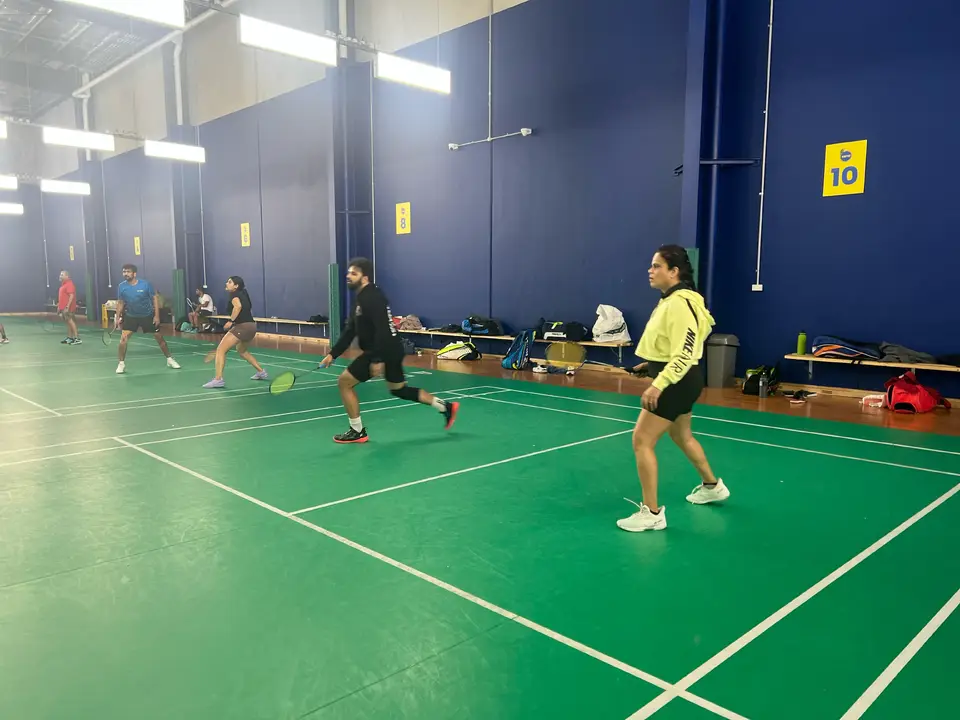
Before you come: choose the right session
Not every social is aimed at the same level. WBi currently lists a Thursday beginner/intermediate social, 8–10 pm, and Saturday adult training, 3:30–5 pm, at Peak Play Badminton Center (formerly Krishna’s Badminton Center). Other sessions cater to intermediate and advanced players.
If you are completely new, returning after a long break or unsure of your level, ask WBi which session to start with. A social is shared game time; it is not a guaranteed coached lesson. Adult training may be the more useful starting point if you want structured instruction.
Check the current session listings for times and venue details, and confirm availability, fees and booking/payment arrangements with the organiser. Listings can change.
What to bring
- Non-marking indoor court shoes. WBi’s guidelines require suitable non-marking footwear. Ask before attending if you are unsure about your shoes.
- Your racket, if you have one. If you need to borrow or hire, ask in advance; do not assume equipment is available.
- Water, a small towel and comfortable sports clothes. Bring what you need for breaks and a change of top if helpful.
- Your confirmed session arrangements. Know your start time and how the organiser wants you to book and pay.
You do not need to buy an expensive racket or a full set of new kit just to ask about joining. Get advice on the essentials first.
From arrival to your last game
Arrive with time to find your feet
Allow time to find the venue and get ready before your session starts. Keep bags away from playing areas. If games are in progress, wait for a rally to finish before walking behind or beside a court.
Check in with the organiser before joining any game. If you cannot spot them, ask a player during a break who is organising the WBi session. Do not step into a court mid-rally to ask.
Say hello—and tell us your experience
Let the organiser know it is your first visit and describe your experience honestly: brand new, occasional casual play, returning player or regular doubles player. Ask how the queue works, where to wait and who will help you join a suitable game.
Try saying: “Hi, I’m here for my first WBi session. I’ve played a little, but I’m still learning doubles. Who should I check in with, and how do I join the rotation?”
Coming alone? Mention that when booking and again when you arrive so you can ask about partner matching. You do not need to pretend you already know everyone.
Get ready, then join when invited
Take time to warm up and settle in. Confirm the playing format and scoring before your first game; do not assume every session uses the same arrangement. Learn your partner’s name and let them know if you are still learning the rules.
Call the score clearly and make sure opponents are ready before serving. Keep encouragement friendly and feedback brief. If you are unsure where to stand or whose turn it is, ask between rallies.
Finish a game, make room, rotate
Under WBi’s social-play guidelines, players rotate after each game unless the organiser sets a different format. Give waiting players priority before starting another game. Ask where to wait for your next turn rather than immediately taking another court.
Partners may change, and the organiser may rebalance games to match playing levels sensibly. This keeps social play inclusive; it is not a promise of a fixed partner or uninterrupted court time. Use the break for water and a breather.
Leave with a clear next step
Thank your partners and opponents, collect your belongings and let the organiser know how the session felt. Ask whether the same session or adult training would suit your next visit, and how to confirm your next place.
Your first session does not need to be about winning. Finding the organiser, understanding the rotation and enjoying a few rallies are useful first steps.
What beginners can expect—and what to ask about
WBi’s guidelines ask players to encourage newcomers, use respectful language and mix partners where possible. You can ask questions and explain what you are comfortable with.
You may also spend time waiting between games, play with people you do not yet know and need a little help with scoring. That is different from a private lesson: coaching, equipment loans, a guaranteed partner and a place on the night should all be confirmed separately.
If you feel unwell or hurt, stop playing and tell the organiser. Report unsafe conditions or inappropriate behaviour rather than feeling you must play on.
First-visit questions
Can I just turn up?
Contact WBi first to confirm a place, the right session for your level and the booking/payment arrangements. This guide does not establish a walk-in policy.
Do I have to know how to score?
Tell the organiser you are learning and ask for help with the format before joining. For a complete beginner, ask whether adult training is a better first step than social games.
Will I play continuously for the whole session?
No continuous court-time guarantee is given here. Social play includes rotation, with waiting players given priority unless the organiser sets a different format.
What if the games feel too fast or too difficult?
Speak to the organiser during a break. Explain what feels comfortable and ask about a more suitable game, session or training option.