Court movement in doubles for casual players.
Two players. One connected team.
Cover the space together, not the same shuttle.
By Western Badminton ·
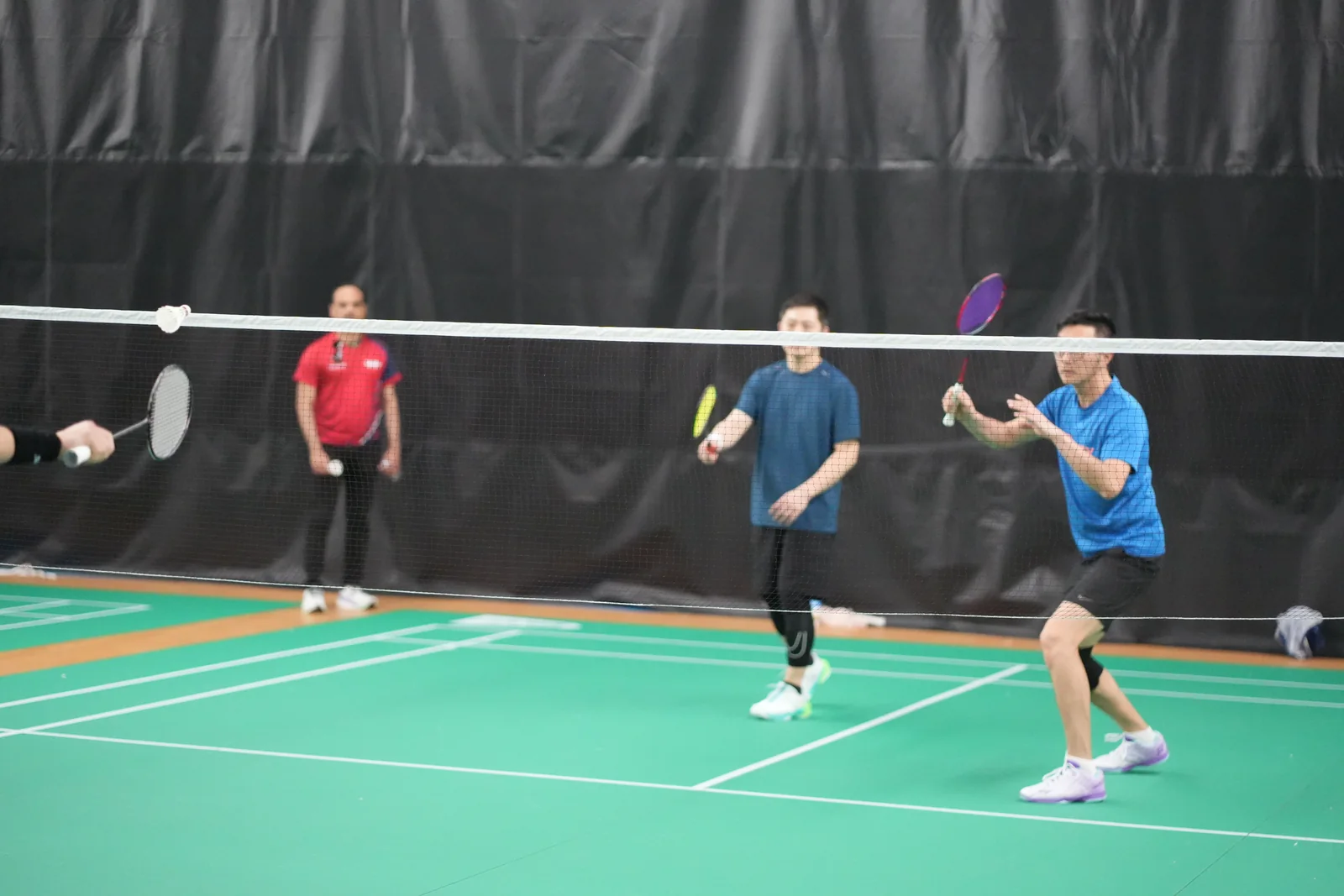
Do you both chase the same shot, leave the back court empty or get stuck playing “my half, your half”? A little shared positioning can make casual doubles feel less hurried.
Start with two useful shapes: front-and-back when attacking, side-by-side when defending. These are starting ideas, not painted parking spaces. Adjust to the shuttle, your partner and what your opponents can play next.
Attacking: one forward, one behind.
Cover the likely reply, not just the shot you have played.
A shared front-and-back shape
When your pair can play downwards and keep the opponents under pressure, the rear partner covers most deep replies. The forward partner looks for shorter net and midcourt returns.
“Front” does not mean standing against the net. Leave room to react and keep the racket ready. The player behind needs space to swing and move.
Badminton Bible’s positioning guide explains these complementary roles. Neither role belongs permanently to one partner.
Defending: share the width.
Give both partners a chance to reach the next attacking shot.
A side-by-side starting point
If your lift gives the opponents a chance to attack, move into a side-by-side shape. Each partner covers a side, rather than leaving one person at the net and the other to defend the whole width.
Keep your knees comfortably bent and racket ready in front. Adjust your depth to the opponent’s hitting position and the shots you need to cover, rather than standing on a particular line.
In a flat exchange where neither pair controls the attack, side-by-side can also be a useful starting shape. As the advantage changes, your positions change too.
Change shape when the rally changes.
Rotation is an adjustment, not a compulsory clockwise run.
The Graduates’ Badminton Club guide illustrates how a high lift or clear can require an attacking pair to spread into defence. Agree beforehand how you will share the sides; use the space already available instead of crossing through each other.
- Your pair lifts high: if the opponent can attack, both prepare to defend across the width.
- Your pair wins the attack: one player can cover forward while the other supports behind. Do not both rush the net.
- The exchange stays flat: stay balanced and read the next contact; do not force a formation change simply because you hit the shuttle.
After a short serve, the server commonly covers forward and the partner supports behind. A high serve or a lifted return may change that picture. Moving during a rally does not change service-court assignments; see our doubles service guide.
Agree the small things before playing.
WBi’s practical cues for a relaxed social partnership.
- Choose clear calls. Agree on “mine”, “yours” and “leave”. Call early enough to help, rather than as two rackets arrive together.
- Discuss the middle. Agree how to handle an uncertain central shuttle. “Forehand always takes it” is too simple for every contact point or left/right-handed pairing.
- Make room for the hitter. Do not run into a partner’s swing. If the situation becomes unsafe, stop and reset instead of trying to rescue the rally.
- Talk between rallies. A quick “I’ll cover forward when you attack” is more useful than a long tactical debate during play.
For casual sessions, one shared cue at a time is enough. Ask a coach to watch a few rallies if you keep crossing paths or leaving the same gap.
Try a short partner practice.
Learn the movement before adding speed.
BWF Shuttle Time Lesson 21 teaches doubles formations with shadow movement and an emphasis on awareness of space, self, opponents and partner. Start slowly and keep the court clear.
- Walk the two shapes. Without hitting a shuttle, find front-and-back and side-by-side positions. Alternate which partner covers forward.
- Add a cue. A helper calls “attack” or “defend”. Move at walking pace into the matching shape, leaving a clear path for your partner.
- Add gentle rallies. With another pair, use controlled shots and pause when unsure where to move. Focus on position rather than winning.
- Review one moment. Between rallies, ask whether both partners had a useful area to cover. Repeat the difficult transition slowly.
This is a WBi practice adaptation, not a speed test. Warm up first, keep loose shuttles off the floor and use a pace everyone can manage. Our footwork guide covers movement foundations.
Should we stay on the same side all game?
No. Side-by-side is useful in defence, but it is not a permanent division of the court. Respond to the rally together and keep track of the correct server and receiver between points.
Does the stronger player always stay at the back?
No. Both partners benefit from learning both roles. Discuss your abilities and comfort, but avoid assigning permanent positions that leave you unable to respond when the rally changes.
Do casual players need complicated rotations?
Start with the two basic formations, clear calls and safe spacing. A coach can introduce more detailed movement patterns once those feel comfortable.
Sources & further practice
References checked on 18 October 2026. Diagrams are WBi illustrations of basic formations, not fixed player locations. A coach can adapt the details to your pair.