Court movement in mixed doubles for casual players.
Build a partnership, not two fixed positions.
A simple plan for sharing the court and enjoying the rally together.
By Western Badminton ·
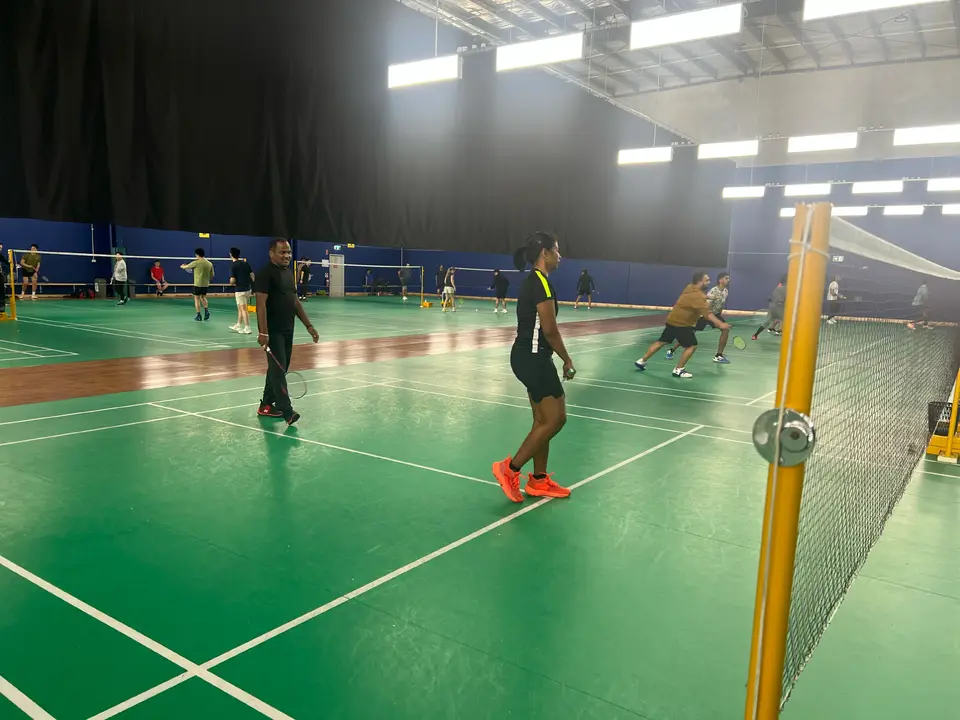
Mixed doubles can feel confusing when one partner is told to stay at the net and the other tries to cover everything else. For a casual game, start with a more useful question: who can cover the next reply, and what space does their partner need to protect?
This guide offers a simple social-play approach. Competitive mixed doubles has more specialised patterns; you do not need to copy every professional rotation to enjoy a connected, well-organised game.
Use strengths without creating fixed jobs.
WBi’s starting point for casual mixed doubles.
Before playing, ask which areas each partner feels comfortable covering. Someone may enjoy net interceptions; the other may feel more confident with deep shots. Use that knowledge as a preference, not a rule that prevents either person moving.
Traditional competitive mixed systems often favour the woman forward and the man behind. That is a tactical convention, not a requirement to freeze there. For social play, WBi recommends adapting to the people, their abilities and the actual rally rather than assigning every shot by gender.
The general starting shapes remain useful: front-and-back when your pair controls an attack, and shared width when defending. Our doubles movement guide has court diagrams showing both shapes.
Discuss the first few shots.
Your opening positions should support the next reply.
The BWF Level 1 coaching manual’s mixed doubles section gives different examples for serving and returning. Their common lesson is to plan the pair’s coverage, not just the individual stroke.
- After a short serve: agree who will cover a tight net reply and who will support the deeper court. Do not both crowd the service line.
- After a return to the net: the returning player may be well placed to cover forward while the partner supports behind.
- After a high serve or lifted return: reassess immediately. The opponents may now have an attacking opportunity, so do not stay in the original positions automatically.
Only the designated receiver returns the serve. Once the rally develops, either partner can take the next shot. Keep service-court assignments separate from tactical movement; our doubles service explanation covers the difference.
When the opponents attack, share the width.
Do not leave one partner defending an entire court.
If your lift gives the opponents a downward attack, side-by-side coverage is a useful basic response. The front player should not remain stranded close to the net while the partner tries to defend both sidelines. Badminton Bible explains the general defensive formation.
Mixed doubles coaching adds detail about angles, lift direction and each partner’s position relative to the hitter. For a casual starting point, prioritise clear space, racket readiness and knowing which side each of you is covering. Ask a coach to help with the more specialised adjustments.
A controlled block or push can help change the rally, but do not rush both players forward just because a defensive shot went over the net. Read the quality of the reply first. For demonstrations, see Badminton Insight’s mixed doubles defence lesson.
Play the shot you can reach, then reconnect.
Do not force a preferred formation during a live rally.
Imagine the partner who usually covers forward is pushed deep. They should play the available shot while their partner covers the exposed space. Running underneath a partner’s swing simply to restore your preferred positions creates a bigger problem than a temporary role change.
Once a comfortable chance appears, adjust together. There is no need to swap after every shot or follow a compulsory clockwise route. At social pace, coverage matters more than making the movement look like a professional pattern.
- Call the uncertain middle early. Agree on “mine”, “yours” and “leave” before playing.
- Give the hitter room. Avoid crossing through a swing or moving directly into the same shuttle.
- Reset between rallies. If a gap keeps appearing, discuss one simple adjustment rather than blaming the person who missed.
Try a gentle mixed doubles practice.
A WBi partner exercise, not a test of speed.
- Agree one opening plan. Decide who covers short replies after your low serve and who supports behind. Try it with each partner serving.
- Walk through a lift. Without hitting, move from your attacking shape into shared defensive coverage. Choose clear routes that do not cross.
- Swap starting roles. Let each partner begin forward and behind. Discuss what cover they need from the other player.
- Add controlled rallies. Ask another pair to play gently. Pause when the formation becomes unclear, then walk through the adjustment.
Keep loose shuttles off the floor, allow space between players and stop if a movement becomes unsafe. Warm up first and practise at a pace both partners can manage.
Must the woman always stand at the front?
No. That is a common preference in competitive mixed attacking systems, not a requirement to stay there throughout a rally. Casual pairs can adapt to their strengths, and both partners need to respond when the shuttle changes the picture.
What if one partner is less experienced?
Choose a manageable pace and one clear coverage cue. Encourage both partners to play and learn; trying to take every shot for the less experienced player can create confusion and remove their chance to improve.
Do we need different scoring rules for mixed doubles?
The doubles service and scoring framework still applies. Follow the format agreed by your club or event; tactical positions do not decide who serves next.
Sources & further learning
References checked on 18 October 2026. The social-play suggestions and practice sequence are WBi adaptations, not a complete competitive mixed doubles system.