Court movement in singles for casual players.
Play the shot. Prepare for the next.
Make recovery part of your rally, not an afterthought.
By Western Badminton ·
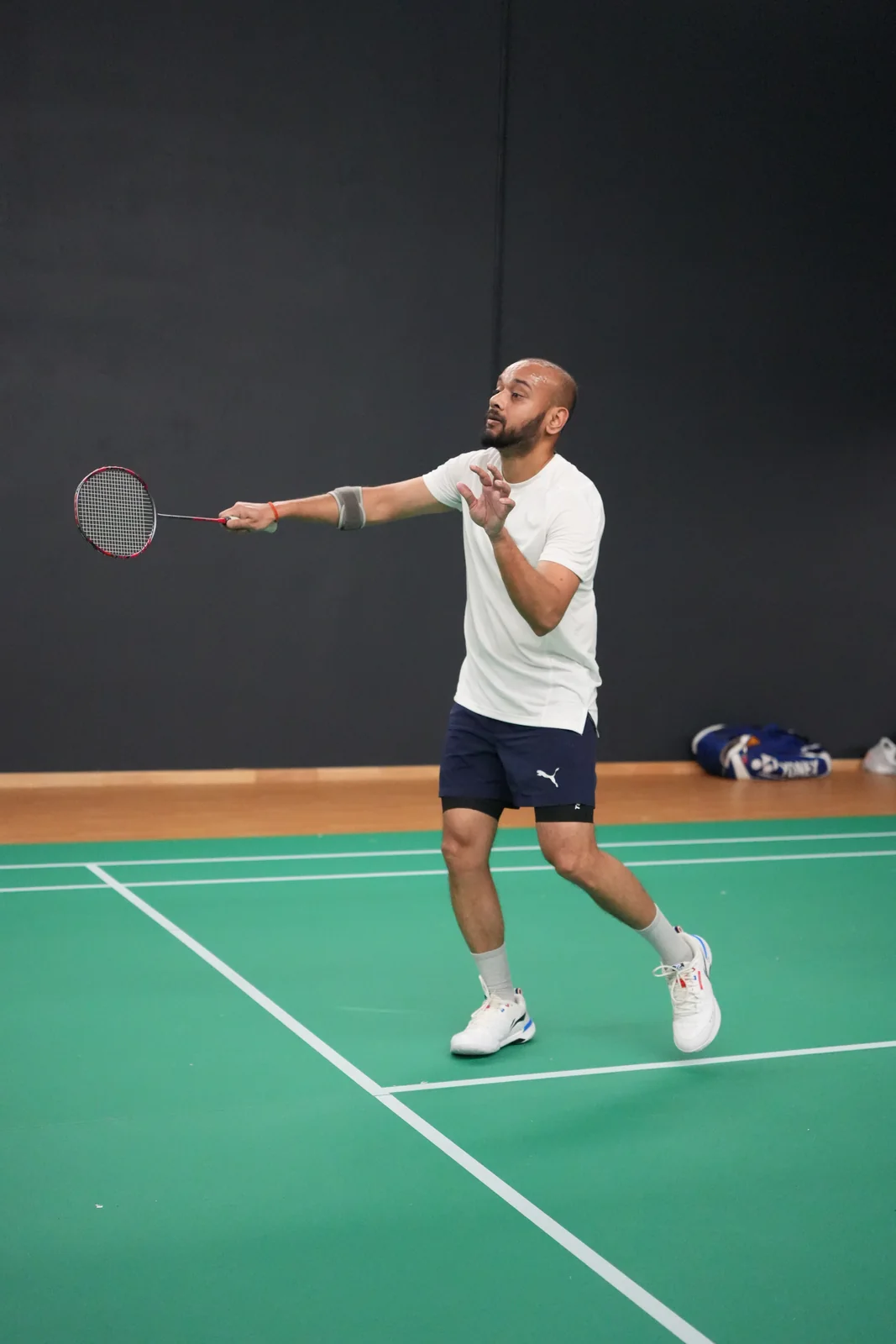
In singles, there is no partner to cover the space you leave behind. It is easy to admire your shot, stay in a corner and then feel late to the next one.
Start with a simple habit: move to the shuttle, play with control, recover towards useful space, then get ready again. The aim for a casual player is repeatable movement, not copying a professional’s speed or jumps.
Recover towards a useful base.
A starting area, not a compulsory stop on one painted spot.
Think coverage, not exact centre.
A broadly central base helps you cover different replies. But the best recovery position depends on your shot, the time available and your opponent’s options.
After a tight net shot you may stay farther forward. After a clear you may need a deeper base. A shot towards one sideline can also shift your position towards that side.
If the opponent is already hitting, prepare to change direction where you are rather than continuing blindly towards an ideal spot. Badminton Bible’s central-base guide explains these adjustments.
Get ready as the opponent hits.
A small preparation movement, not a big jump.
The split step is a small movement that helps you push off towards the next shot. The BWF Level 1 movement manual describes a shallow jump beginning just before the opponent strikes, with a balanced landing around or just after contact.
For a casual starting point, keep the movement low, your knees comfortably bent and your upper body relaxed. Practise the timing slowly with a coach or partner rather than jumping high or guessing a direction early.
You will not always reach your preferred base before the next shot. Being prepared to respond matters more than finishing a journey to a fixed point.
Practise the return journey too.
WBi’s simple cue: reach, hit, recover, ready.
Do not finish a practice repetition at the moment you touch the shuttle. Include a controlled return towards your next useful position. That makes recovery part of the skill instead of something you remember only after the opponent replies.
- Going forward: arrive under control rather than stretching for a shuttle you cannot reach safely.
- Going deep: learn the turn and footwork with a coach instead of rushing backwards while leaning away from the shuttle.
- Coming back: use manageable steps and regain balance. Avoid one huge movement that leaves you unable to respond.
There is no single step count for every player and every corner. Your starting position, reach and time available change the movement. Ask a coach to check a comfortable pattern before adding pace.
See our badminton footwork guide for a broader introduction.
Choose a shot you can recover from.
Better movement also involves better decisions.
Singles is not a test of hitting every shuttle as hard as possible. BWF Shuttle Time’s singles lesson introduces using court space, depth and changes of pace while considering your own position and the opponent.
For WBi casual practice, try a rally where the goal is controlled placement rather than a winner. Notice which choices leave you balanced and which make the next reply difficult to reach.
Build up from a smaller court.
A WBi practice progression for relaxed singles.
- Walk two directions. On a clear court, move gently towards a front area and recover. Repeat towards a rear area. Keep the movement comfortable and do not add a shuttle yet.
- Use predictable feeds. Ask a partner to send easy shots to one agreed area. Play a controlled return and include the recovery before the next feed.
- Try half-court singles. Agree the boundaries first and use front-to-back placement without smashes. Keep it a practice game, not a test of endurance.
- Add width gradually. Move to the normal singles court when both players are ready. Focus on one cue: get ready again after each shot.
Half-court tactical games also feature in BWF Shuttle Time Lesson 19. The progression above is a WBi adaptation for casual practice.
Warm up first, keep loose shuttles off the floor and allow recovery breaks. Stop if you feel pain, dizziness or cannot move safely; you do not need to chase every shuttle. Our warm-up and cooldown guide can help you plan the session.
Do I always return to the exact middle?
No. Recover towards a useful base that reflects the shot and the likely replies. It may be farther forward, deeper or slightly to one side.
Which sidelines apply in singles?
The inner sidelines and full back boundary define the normal singles court. During a standard singles serve, the service target is narrow and long. A line forming the relevant boundary counts as in.
Can a beginner practise on half a court?
Yes, if both players agree the practice boundaries. It can simplify front-to-back movement before adding the full singles width. It is a training adaptation, not a change to official match boundaries.
Sources & further learning
References checked on 18 October 2026. The diagram and practice progression are WBi illustrations and adaptations, not a personalised coaching programme.